Commentary: COVID-19 reverses Philippines' decade of economic progress
Ad
Commentary
Commentary: COVID-nineteen reverses Philippines' decade of economic progress
The Philippines' model of growth is built around the mobility of people, making it vulnerable to disease outbreak, says a government studies professor.

17 Aug 2022 06:05AM (Updated: 17 Aug 2022 06:05AM)
MANILA: In 2019, the Philippines was one of the fastest growing economies in the earth. Information technology finally shed its "sick homo of Asia" reputation obtained during the economic collapse towards the end of the Ferdinand Marcos government in the mid-1980s.
Subsequently decades of painstaking reform – not to mention paying back debts incurred under the dictatorship – the land's economical renaissance took root in the decade prior to the pandemic.
Posting over six percent average annual growth betwixt 2010 and 2022 (computed from the Philippine Statistics Dominance information on Gdp growth rates at constant 2022 prices), the Philippines was touted as the next Asian tiger economy.
That was prior to COVID-19.
The rude awakening from the pandemic was that a services- and remittances-led growth model doesn't do likewise well in a global disease outbreak. The Philippines' economic growth faltered in 2022 – entering negative territory for the offset time since 1999 – and the country experienced one of the deepest contractions in the Association of southeast asian nations (Association of southeast asian nations) that yr.
And while the authorities forecasts a slight rebound in 2021, some analysts are concerned over an uncertain and weak recovery, due to the country's protracted lockdown and inability to shift to a more efficient containment strategy.
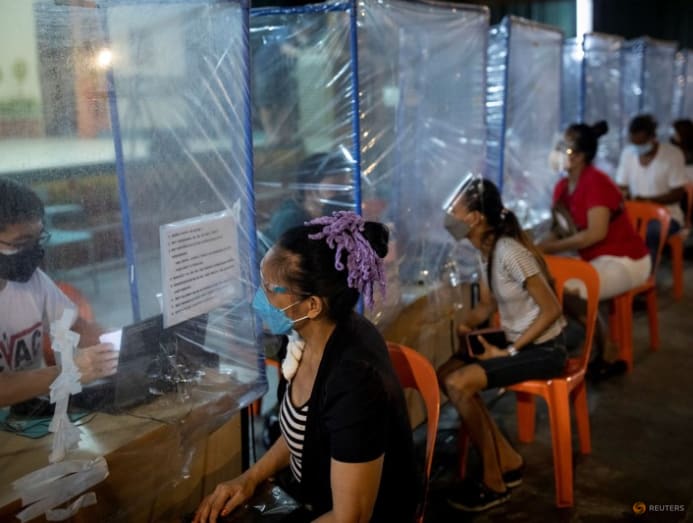
The Philippines has relied instead on callous mobility restrictions across large sections of the country's fundamental cities and growth hubs every time a COVID-nineteen surge threatens to overwhelm the country's health system.
WHAT WENT Wrong?
How does one of the fastest growing economies in Asia falter? It would be besides simplistic to arraign this all on the pandemic.
First, the Philippines' economic model itself appears more vulnerable to illness outbreak. It is built around the mobility of people, yet tourism, services, and remittances-fed growth are all vulnerable to pandemic-induced lockdowns and consumer confidence reject.
International travel plunged, tourism came to a grinding halt, and domestic lockdowns and mobility restrictions crippled the retail sector, restaurants, and hospitality manufacture.
Fortunately, the country's business process outsourcing (BPO) sector is demonstrating some resilience – yet its main markets have been hit heavily past the pandemic, forcing the sector to rapidly upskill and adjust to emerging opportunities under the new normal.
2nd, pandemic handling was also problematic. Lockdown is useful if it buys a country time to strengthen health systems and test-trace-treat systems. These are the building blocks of more efficient containment of the disease.
Nonetheless, if a land fails to strengthen these systems, then it squanders the time that lockdown affords information technology. This seems to exist the case for the Philippines, which made global headlines for implementing i of the world'south longest lockdowns during the pandemic, yet failed to flatten its COVID-19 curve.
At the time of writing, the Philippines is once more headed for some other hard lockdown and information technology is still trying to graduate to a more efficient containment strategy amidst rise concerns over the Delta variant which has spread across Southeast Asia.
It seems stuck with on-over again, off-again lockdowns, which are severely damaging to the economy, and will likely create negative expectations for future COVID-19 surges.
If the Delta variant and other possible variants are near-term threats, then the lack of efficient containment can be expected to force the country dorsum to draconian mobility restrictions as a last resort.

Meanwhile, just two months of social transfers (ayuda) were provided by the central government during 16 months of lockdown past mid-2021. All this puts more pressure on an already weary population reeling from deep recession, chore displacement, and long-term risks on homo development.
Low social transfers support in the midst of joblessness and rising hunger is also probable to weaken compliance with mobility restriction policies.
Tertiary, the Philippines suffered from delays in its vaccination rollout which was initially hobbled by implementation and supply issues, and later affected past lingering vaccine hesitancy. These are all likely to delay recovery in the Philippines.
LESSONS FOR THE PHILIPPINE GOVERNMENT
Past now there are many clear lessons both from the Philippine experience and from emerging international best practices. In order to mount a more successful economic recovery, the Philippines must address the following cardinal policy issues.
First, it must build a more efficient containment strategy particularly against the threat of possible new variants principally by strengthening the exam-trace-treat system.
Based on lessons from other countries, test-trace-care for systems usually besides involve comprehensive mass-testing strategies to meliorate inform both the public and private sectors on the truthful country of infections among the population.
In addition, integrated mobility databases (not fragmented city-based ones) also capacitate more effective and timely tracing. This kind of detailed and timely data allows for government and the private sector to better coordinate on nuanced containment strategies that target areas and communities that demand assist due to outbreak risk.
And unlike a generalised lockdown, this targeted and information-informed strategy could allow other parts of the economic system to remain more open than otherwise.
Second, the Philippine regime must strengthen the sufficiency and transparency of direct social protection in club to give immediate relief to poor and depression-income households already severely impacted by the mishandling of the pandemic.
This requires a rebalancing of the budget in favour of education, health, and social protection spending, in lieu of an over-emphasis on build-build-build infrastructure projects.
This is likewise an opportunity to enhance the social protection organisation to create a safety net and concurrent database that covers non just the poor but also the vulnerable low- and lower-middle- income population.
The primary concern here would be to introduce social protection innovations that prevent middle income Filipinos from sliding into poverty during a pandemic or other crisis.
Third, the Philippines must ramp-up vaccination to comprehend at least seventy percentage of the population every bit soon equally possible, and enlist the farther back up of the individual sector and civil society in society to continue improving vaccine rollout.
An effective communications campaign needs to be launched to counteract vaccine hesitancy, building on trustworthy institutions (like academia, the Catholic Church, civil society and certain private sector partners) in order to better protect the population confronting the threat of Delta or another variant affecting the Philippines.
It will also assist if parts of government could stop the politically-motivated fearmongering on vaccines, equally had occurred with the dengue fever vaccine, Dengvaxia, which continues to sow doubts and fears among parts of the population.

Fourth, the government should create a build-back-better strategy anchored on universal and inclusive healthcare. Amid other things, such a strategy should acknowledge the critically of import office of the private sector and civil order in pandemic response and healthcare sector cooperation.
Information technology should likewise underpin pandemic response around lasting investments in institutions and technology that enhance contact tracing (eastward-platforms), testing (labs), and universal healthcare with lower out-of-pocket costs and higher inclusivity. This requires a more than inclusive, well-funded, and meliorate-governed health insurance system.
As much of ASEAN reels from the spread of the Delta variant, it is critical that the Philippines takes these steps to help abate concerns over the land'southward preparedness to handle new variants emerging, while also recalibrating expectations in favour of resuscitating its economy.
Only then can the Philippines avoid becoming the sick man of Asia again, and return to the rapid and steady growth of the pre-pandemic decade.
Ronald U Mendoza is Dean and Professor at Ateneo Schoolhouse of Government, Ateneo de Manila University, This commentary start appeared on Brookings' blog, Order From Chaos.

Recent Searches
Trending Topics
Source: https://cnalifestyle.channelnewsasia.com/commentary/covid-19-coronavirus-philippines-manila-lockdown-economy-gdp-290381
0 Response to "Commentary: COVID-19 reverses Philippines' decade of economic progress"
ارسال یک نظر